Suspicious in Texas?
Mar 31, 2026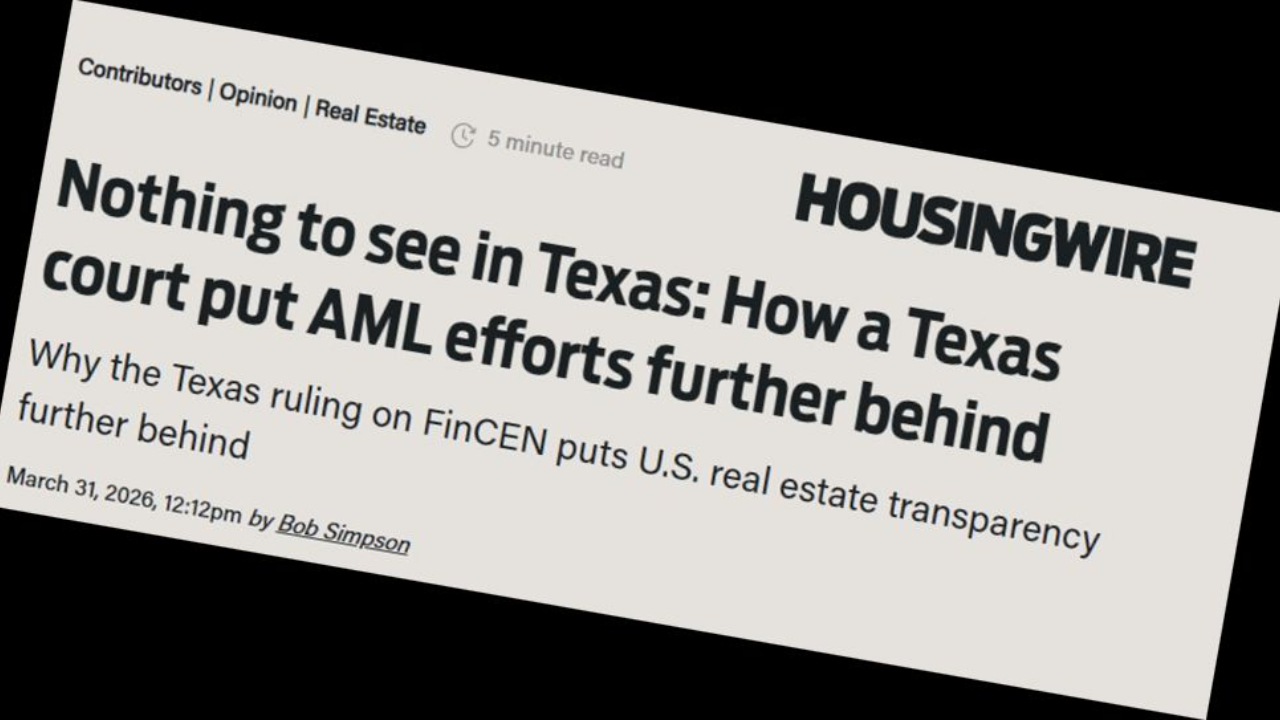
Introduction
In much of the world, the fight against money laundering is focused on real estate like a sniper on the high ground. The fight centers on shell companies. All non-rogue nations have, to a larger or lesser extent, enacted rules to expose beneficial owners of the companies that buy and sell property. By contrast, the United States continues its halting, Sisyphean climb up the same hill.
Here in the U.S., it seems that each attempt to advance meaningful real estate transparency has to overcome the wearying gravity of deeply embedded privacy concerns, political resistance, and the opposition of well-resourced interests. A Texas federal court’s decision striking down FinCEN’s 2024 real estate reporting rule (The Rule) is the latest judicial manifestation of this gravitational drag. (Flowers Title Companies, LLC v Scott Bessent).
AML Efforts Worldwide
It’s been exactly 40 years since money laundering became illegal in the United States. The TV show Miami Vice began in 1984, and by 1986, Congress had decided that laundering money was bad. The rest of the world joined the chorus, individual nations singing with varying degrees of enthusiasm.
Now, four decades on, we’ve seen the end of both the Soviet Union and Don Johnson’s pastel suits, and we’ve witnessed the rise of Russian Oligarchs as they plundered Soviet minerals and washed their dirty money through Londongrad. High-end real estate, whether high-rises or low-country ranches, has always been the make-sense way to legitimize eight-figure fortunes. One purchase and the money is clean. Walter White would have to wash 100,000 cars to match one NYC apartment.
Over the intervening years, organizations have been formed to join the fight. In 1989, the Financial Action Task Force (FATF) was formed in Paris during the G7 Summit, and fighting money-laundering was its raison d’etre. Then, in 2000, the Wolfsberg Group was formed by major banks like Deutsche, JPMorgan and Citi. It’s an exclusive club, private, of course, that has a voice in all things that affect their handling of client money. The FATF is like the refs at your private school basketball game. The Wolfsberg Group are the donors that built the arena.
In the US, we have FinCEN. It’s a division within Treasury that determines U.S. policy as it implements the Bank Secrecy Act of 1970 and subsequent legislation. Under that aegis, it created Geographic Targeting Orders (GTOs) to keep the oligarchs from buying up every apartment on Central Park South. FinCEN applied GTOs to various other major metropolitan areas around the country, as well. In a GTO, corporate ownership must be disclosed - no shell company shenanigans.
Then in 2024, FinCEN created “The Rule” by which it attempted to apply a GTO-like approach to all non-financed transactions throughout the U.S. It was to go into effect in December 2025.
The Litigation
Flowers Title Companies decided to fight back. It filed suit in the Eastern District of Texas to block the implementation of The Rule. All parties stipulated that FinCEN has authority to regulate “suspicious transactions.” However, Flowers argued that non-financed transactions are not suspicious, and that therefore, FinCEN had no statutory authority to spread GTOs across the US.
For FinCEN’s part, it argued that non-financed deals are suspicious, citing various statistics, including that “from 2017 to early 2024, approximately 42 percent of non-financed real estate transfers captured by the Residential Real Estate GTOs were conducted by individuals or legal entities on which a SAR has been filed.” The thrust was that non-financed transactions are sketchy.
However, siding with Flowers, the Texas court wrote that FinCEN’s experience with non-financed transactions did not mean that all non-financed transactions are suspicious. It wrote, “the agency fails to explain or show how non-financed residential real estate transactions are categorically 'suspicious.’
A fair interpretation of Texas’ opinion is that Texas refuses the concept of guilt by association. As a result, Texas held that FinCEN’s actions are beyond the scope of its authority.
Reaction
Disagreement with Texas was swift. Some noted that other jurisdictions have already upheld FinCEN’s right to establish GTOs.
Others, like Ian Gary, executive director of the FACT Coalition, have adopted a more derisive tone, stating, “In striking down this rule, the district court in Texas has just sided with cartels, money launderers, and U.S. adversaries and given them free license to continue moving their dirty cash through U.S. real estate.”
The Texas court admits that Geographic Targeting Orders (GTOs) have been deployed in New York City, but, in essence, dismissed their use in Texas, suggesting that what works in NYC does not work in rural America. This is a curiously parochial view.
Consider the 2023 sale of Jeffrey Epstein’s Zorro Ranch in New Mexico. The property was sold by his estate, with proceeds intended for victim compensation, yet the identity of the buyer was initially concealed. Then three years later it was revealed that the purchaser was connected to the family of a Texas developer. While such opacity may be legally permissible, this arguably called for a closer look, given that the property had been Epstein’s.
Conclusion
Over more than four decades, the global fight against money laundering has matured into a coordinated effort between governments and NGOs. The Paris-based Financial Action Task Force, with the input of dozens of countries, created its Forty Recommendations, aimed at “best practices” to control money laundering.
The twenty-fourth of those recommendations calls for disclosure of beneficial owners, to protect against shell corporations hiding dirty money. And nation states have complied with varying degrees of enthusiasm.
In Ireland, for example, every transfer is public record, and every beneficial owner is disclosed. Similarly, France collects information on all beneficial owners, but due to strict privacy laws, they limit dissemination of that information to those with a reason to know. But they collect it. The effect is that no one is allowed to anonymously sell a property for $10M to a Russian Oligarch. Or transfer an Epstein property anonymously.
Against that backdrop, it is jarring to see judicial reasoning that treats all-cash, non-financed transactions as inherently unsuspicious. The Texas ruling is out of step with other courts in the U.S. and with the international community’s fight against money laundering.
Ultimately it may be up to Congress to declare that anonymous, non-financed transactions are inherently suspicious.
